
Whoa!
I still remember the first time I chased a stuck SOL transfer—felt like reading yesterday’s bank ledger through a keyhole.
Solana moves fast, and Solscan helps you keep up without needing to be a node operator.
Initially I thought a blockchain explorer was just a pretty UI for transactions, but then realized it’s the forensic toolkit every Solana user should learn.
My instinct said I could save hours of worry if I learned a few simple habits early on.
Seriously?
Yeah—seriously.
Most users only glance at hashes and say “ok” and move on.
But a few clicks in Solscan often reveal whether a tx is pending, failed, or merely delayed by a cluster issue.
On one hand the UI is straightforward, though actually there are nuances most guides skip over.
Hmm… somethin’ about token pages bugs me.
I’ll be honest: token metrics can be misleading if you don’t understand holder concentration and supply mechanics.
Something felt off about a token I tracked—high volume, low liquidity—and Solscan showed a single wallet holding a giant portion of the supply.
Actually, wait—let me rephrase that: it showed multiple wallets tied to the same custodian, which changed my risk read.
So you start with a number, then you have to look for patterns and provenance.
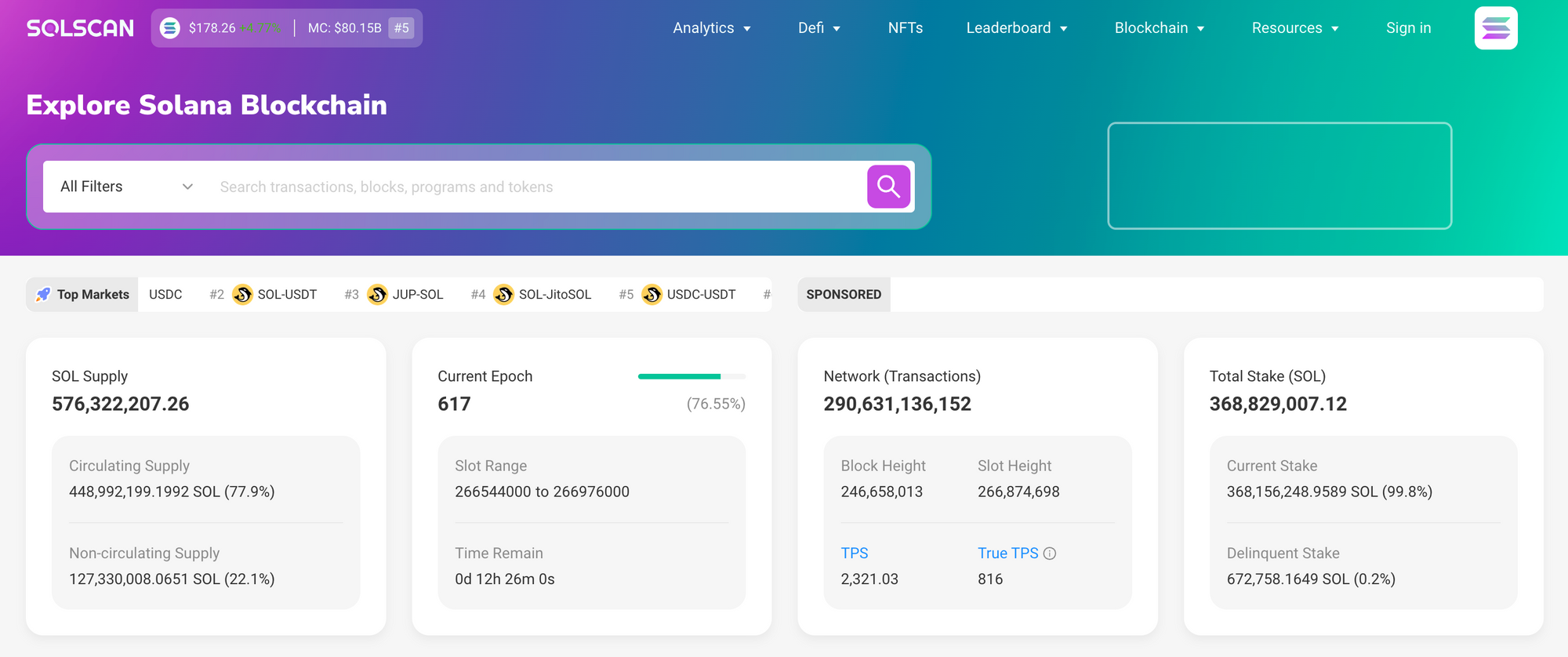
Why I keep going back to the solscan explorer official site
Short answer: it gives clarity.
Longer answer: Solscan surfaces raw transaction data, token metadata, program interactions, and historical charts in one place, which is surprisingly rare.
You can search by address, tx hash, block height, or token mint; each view ties into the rest so you can pivot quickly from a suspicious transfer to the token’s holder distribution to related program calls.
If you’re tracking an airdrop, auditing a mint, or confirming a wallet’s activity, those cross-links save you from guessing.
Oh, and by the way… the API is doable if you want to automate lookups, though rate limits and parsing decimals are things to handle.
Here’s the thing.
Understanding confirmations and finality on Solana is very very important.
A transaction can show as “confirmed” but not fully finalized across forks, which matters if you’re watching for reorgs or heavy DeFi activity.
Look at the “status” and the number of confirmations; then check the slot time and cluster health.
If the cluster is congested, fees spike and RPC responses slow—this explains a lot of false alarms.
Practical tips I use daily:
1) Always paste the raw tx hash into Solscan rather than relying on wallet UI links; that avoids redirects and bad state.
2) Cross-check the program invoked—system transfers look different from token program calls.
3) Inspect “inner instructions” when a multisig or program-derived account is involved.
These three steps often reveal whether a move was user-initiated or program-automated.
On deeper digs I often run into token mints with sparse metadata.
Sometimes the symbol is missing.
Sometimes the decimals are wrong in a UI that aggregates data—so your $ balance looks off.
If the on-chain metadata is incomplete, you gotta triangulate using the mint address, recent mints, and holder history.
That detective work is tedious, but it prevents misreading balances as profit or loss.
Tooling features worth knowing:
– Token Holder lists: you can sort by balance and see distributions; if one wallet owns >50%, think about risk.
– Transactions per slot and signatures per block: helps you feel cluster load.
– Program interaction tabs: useful when trying to interpret DeFi strategy calls.
– NFT mint and metadata lookup: can show original creators and creators’ royalties.
Each of these is a lens; use several lenses.
I’m biased, but I prefer to check the holder history rather than relying on market cap figures shown elsewhere.
If holders jumped from 10 to 10,000 in a single hour, that’s a red flag for minted faucets or a bot-distribution.
Also, watch for repeated transfers between a small set of wallets—wash patterns are surprisingly common.
My instinct flagged a token with lots of tiny transfers and no liquidity—turned out to be a dust-siphon scheme.
Lesson: pattern recognition beats raw numbers when you’re parsing token legitimacy.
Technical caveats:
– Solana uses lamports; convert properly (1 SOL = 1,000,000,000 lamports).
– SPL tokens have decimals defined by their mint metadata; UI rounding can hide microbalances.
– When reading program logs on a tx page, decode base64 outputs carefully—some programs emit useful debug strings, others don’t.
If you build scripts against the explorer or its API, test on a few known txs to validate parsing logic.
Community workflows that helped me:
I follow a few dev channels and keep a short checklist for incident triage—cluster, tx-status, program, holders, and recent related txs.
It reduces cognitive load in a panic.
Don’t try to inspect everything in one go; triage fast, then deep-dive.
Oh—and keep screenshots when you find weird states; they save explanation time when you report issues to devs or governance.
Common questions I get
How do I verify a token is the real project?
Look for verified metadata when available, but also cross-check the mint address from official project channels.
Check recent token creator transactions, creator addresses on NFT mints, and whether the project’s social links point to the same mint.
If in doubt, ask in the project’s official forum and post a Solscan link to the mint and a couple of txs—evidence speeds answers.
What does “inner instruction” mean on a transaction?
Programs sometimes invoke other programs within a single transaction; inner instructions show those nested calls.
They reveal token swaps, program-derived account creations, or cross-program transfers that the top-level instruction summary might not expose.
Pay attention to them for DeFi transactions, because the actual asset movements often live there.
Can I rely solely on Solscan for security audits?
No.
Solscan is a powerful observational tool but not a substitute for formal audits, static analysis, or running a node.
Use it to gather evidence and surface anomalies, not as the only trust mechanism.
Alright—closing thought, and I’ll try not to be preachy.
Solscan won’t make you infallible.
But it will make you a lot less surprised by somethin’ odd when a transaction goes sideways.
Over time you build pattern memory—what normal looks like, and what noise looks like—and that experience is the real edge.
So bookmark a few token mints, keep a short checklist, and when you see a weird hash, go see what the ledger actually says…