
Many experienced DeFi users assume that a wallet is just a key manager and network switcher. That assumption is misleading. The dangerous gap is not possession of keys alone but the opacity of what a signed transaction will actually do once executed. Rabby addresses that gap with transaction simulation and layered risk scans; understanding how these mechanisms work, their limitations, and the trade-offs they introduce is essential for advanced users deciding which multi-chain wallet to use in the US market.
The opening claim — that blind signing is the dominant attack vector — is supported by how approvals, multi-step swaps, and cross-chain relays operate: a single signed message can grant ongoing token approvals, move unexpected token amounts, or trigger complex contract logic. A wallet that simulates the transaction and reports exact token deltas and fee estimates closes a large portion of that attack surface, but it does not eliminate systemic risks such as compromised private keys, bugs in audited contracts, or social-engineering attacks outside the wallet UI.
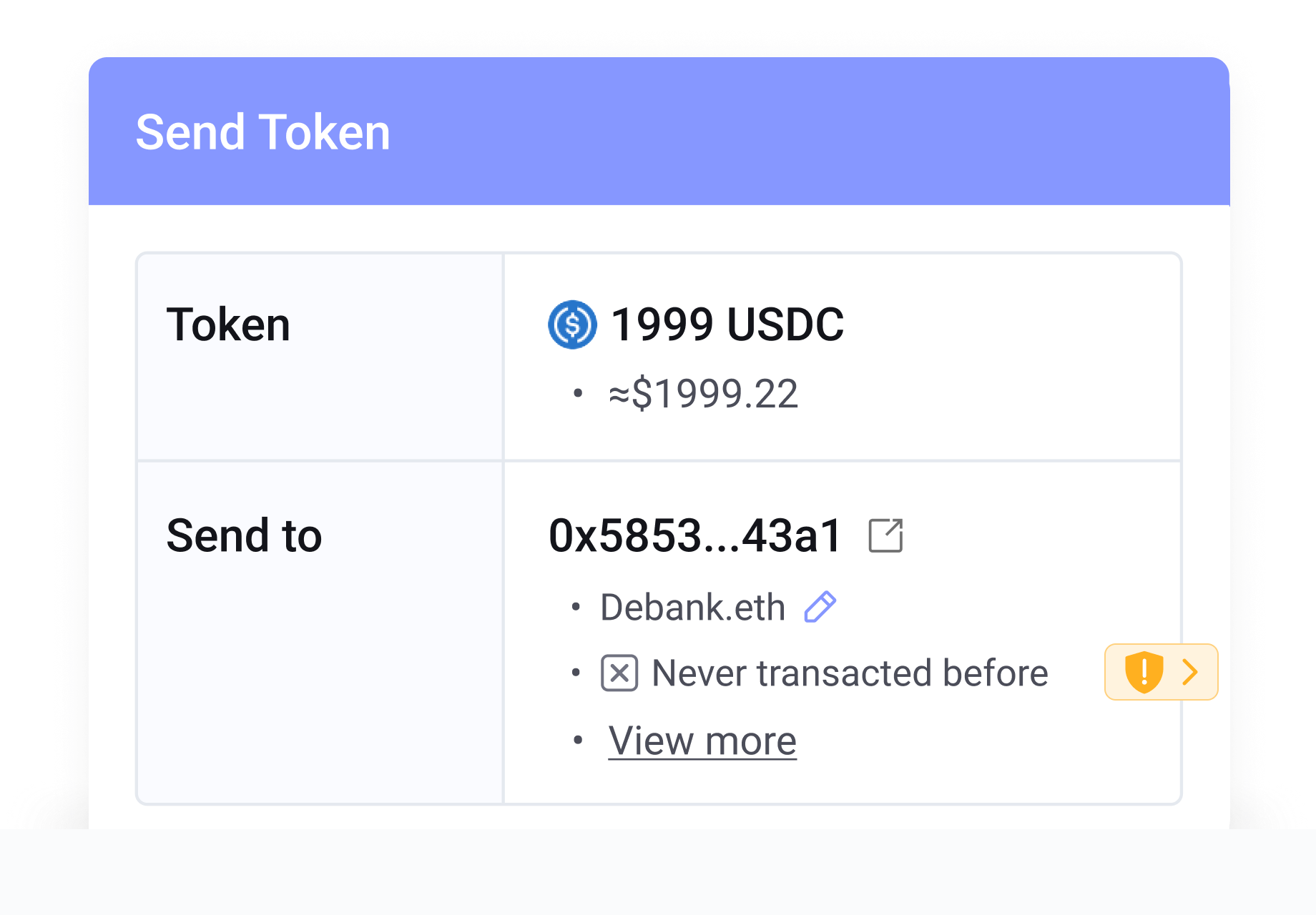
How transaction simulation works and why it changes user decisions
At a mechanism level, transaction simulation replays the intended transaction on a node or local EVM fork before signing. The wallet inspects the resulting state changes — token transfers, approvals, contract calls — and converts them into human-readable deltas: “You will send X tokens, you will grant allowance Y to contract Z, you will pay gas of $N.” This removes guesswork about inferred behavior that might be hidden inside a single transaction payload or aggregated across batched operations.
For a DeFi power user, that simulation changes behavior in three concrete ways: it reduces the likelihood of accepting malicious approval requests, it surfaces hidden fee or slippage pathways (for example, intermediary token hops that inflate front-running risk), and it enables a different mental model when interacting with composable dApps — you evaluate post-state, not just intent. That transition from intent-focused to state-focused decision-making is the sharp mental-model improvement readers should internalize.
Rabby’s implementation: what it offers, and the boundaries you must know
Rabby combines transaction simulation with a pre-transaction risk scanner that flags known hacked contracts, suspicious approval patterns, and non-existent recipient addresses. It also shows precise token balance changes and estimated fee costs before you sign. These mechanisms are the wallet’s core defensive design and are the primary differentiator from MetaMask, Trust Wallet, and Coinbase Wallet where simulation is less central.
There are important boundaries. Simulation is only as accurate as the node state and the RPC endpoint used; edge cases include mempool-reordering attacks, oracle-dependent contracts that behave differently between simulation and execution, and time-dependent or block-dependent logic. Rabby’s simulation reduces blind-signing risk but does not guarantee correctness in scenarios where on-chain state will change between simulation and inclusion in a mined block. Users should therefore treat simulation as probabilistic evidence, not a formal proof of safety.
Trade-offs: convenience, performance, and security posture
Automatic network switching and cross-chain gas top-up are convenience features that materially reduce operational friction when working across 90+ EVM chains. However, convenience can widen the attack surface. Automatic switching reduces user error (wrong network, failed transactions) but also means the wallet must manage many RPC endpoints and chain-specific quirks — each endpoint choice affects simulation fidelity. Power users must balance convenience against a tighter control model where they select reliable RPCs and confirm that simulations use the same endpoints they trust.
Rabby’s open-source MIT codebase and hardware-wallet integrations (Ledger, Trezor, Keystone, and others) are long-term strengths because they allow independent audits and secure key isolation. But open-source status is not a substitute for secure operational practices: institutional setups should still pair Rabby with enterprise custody like Gnosis Safe or Fireblocks for multi-sig protections and key redundancy. The wallet’s integrations with Gnosis Safe and enterprise vendors indicate it’s intended to sit inside higher-trust architectures rather than replace them.
What Rabby does not solve (and what to watch instead)
There are several clear limitations. Rabby lacks a built-in fiat on-ramp and native staking inside the wallet; users in the US will therefore rely on exchanges or third-party on-ramps to fund accounts and separate staking tools for yield. Past incidents — notably the 2022 Rabby Swap exploit — show that even teams that prioritize security can suffer contract-level failures. The response then (freezing the contract and compensating users) is instructive: incident response capability matters as much as pre-transaction warnings.
Another practical limitation is that approval revocation and risk warnings are reactive defenses. They reduce exposure but do not prevent zero-day contract vulnerabilities or social-engineered consent where a user is convinced to approve a malicious contract. Users should pair the wallet’s native tools with operational rules: minimize blanket approvals, limit allowance amounts to what is needed for a single interaction, and routinely use the revocation tool after one-off interactions.
Decision framework: when to prefer Rabby and when to layer additional protections
For a US-based DeFi power user, consider a three-layer checklist:
– If your priority is reducing blind-signing risk and you frequently interact with unfamiliar dApps or complex DeFi composability, Rabby’s transaction simulation and pre-transaction scanning make it a strong first-line wallet.
– If you operate institutional flows, custody of large balances, or need coordinated governance, treat Rabby as the front-end of an architecture anchored by multi-sig or enterprise custody (Gnosis Safe, Fireblocks, Amber, Cobo). Rabby’s integrations make this pattern practical.
– If you need fiat on-ramps or in-wallet staking, expect to supplement Rabby with exchanges or staking-specific providers; Rabby’s absence of these native features is a known trade-off for focusing on security tooling and composability across many chains.
Practically: install the extension on a separate browser profile, pair it with a hardware wallet for large-value operations, enable the ‘Flip’ toggle to compare behavior with MetaMask, and use the approval revocation tool weekly. Those operational rules convert Rabby’s features into measurable risk reductions for active DeFi users.
Where this category is headed — signals to watch
Transaction simulation as a built-in wallet primitive is likely to become standard for advanced users because it directly addresses the principal signing risk. Signals to monitor include wider adoption of standardized simulation APIs across wallets, improvements in deterministic simulation for oracle-dependent contracts, and broader enterprise integrations that make wallets part of auditable custody stacks. However, any progress depends on the quality and decentralization of RPC infrastructure and how wallets manage node diversity to avoid single-point-of-failure simulations.
Another trend to watch is UX convergence: wallets that combine rigorous simulation with simple approval workflows will win mainstream trust. But adoption will hinge on clear evidence that simulations materially reduce losses in the wild; until then, simulation is a strong hedge but not a panacea.
FAQ
Does Rabby stop all smart contract exploits?
No. Rabby’s simulation and pre-transaction scans reduce blind-signing and flag known risky patterns, but they cannot prevent exploits rooted in contract logic, oracle attacks, or private-key compromise. Simulation is an important defensive layer, not a complete security guarantee.
How should I install and configure Rabby to maximize safety?
Install the extension on a dedicated browser profile, connect a hardware wallet for key custody for high-value transactions, set up automatic network switching carefully, and configure the revocation tool to expire allowances after single-use. For institutional use, pair Rabby with a multi-sig custody provider like Gnosis Safe or Fireblocks.
Is transaction simulation reliable across all chains Rabby supports?
Simulation reliability varies with RPC endpoint fidelity and contract dependencies (oracles, block-timestamp logic). Rabby supports simulation across many EVM chains, but users should be aware of chain-specific quirks and validate that the RPC used for simulation matches the one they trust for execution.
Where can I learn more or get Rabby?
You can find official installation guidance and deeper product details at rabby, which provides downloads, platform options, and links to audits and integrations.
In short: treat transaction simulation as a powerful risk-reduction tool that transforms how you evaluate DeFi interactions—from guessing intent to inspecting the predicted state. For US-based power users, Rabby is worth trialing as part of a layered security posture, but it should be combined with hardware custody, multi-sig for significant holdings, and disciplined operational practices that limit approvals and exposure.